Arbitrage betting means backing every outcome of a market at different books when their prices disagree enough that the implied probabilities add up to less than 100%. If every leg is filled at the price you saw, under the same settlement rules, every outcome returns the same amount. That "if" is where arbs fail, so this guide works through a real two-way soccer arb recorded in the DataOdds terminal on 2026-11-06, including what happened to it 40 seconds later.
What is arbitrage betting?
Arbitrage betting is staking on every outcome of one market across different sportsbooks, exchanges or prediction markets, sized so that each outcome pays back the same amount. It is only possible when the books disagree enough that the combined implied probability of the best prices falls below 100%.
Normally it doesn't. One book's prices on a market add up to more than 100%, and the excess is its margin, the vig (see how to remove the vig). An arb is the rare case where taking the best price on each side, from different books, pushes the total below 100%.
Arbitrage is a price relationship, not a prediction. It says nothing about who will win. It only says that, at these prices, the outcomes are covered for a small margin, as long as you get every price.
How do you calculate an arb and split the stakes?
Convert each price to an implied probability, add them up and check that the total is below 1.
Implied probability   = 1 / decimal odds
Arb exists when       S = sum of (1 / decimal_i) < 1
Arb margin            = 1 / S - 1        (return on total stake)
Stake on leg i        = Total x (1 / decimal_i) / S
We quote the margin as 1 / S − 1: what you get back above the total amount staked, as a share of that total. It matches the margins shown in the screenshots below. Some calculators quote 1 − S instead, which comes out slightly smaller for the same prices.
The stake formula sizes each leg so every outcome pays the same. To convert American odds: decimal = 1 + odds / 100 for plus prices, and 1 + 100 / |odds| for minus prices.
What does a real soccer arb look like in DataOdds?
This is the Arbitrage alerts feed for a saved alert rule covering soccer, two-way markets, with a 0.5% minimum margin. It was recorded in the DataOdds terminal on 2026-11-06 at 10:40 ET (15:40 UTC). The prices have changed since; they are here to show the maths, not as a bet on any match.
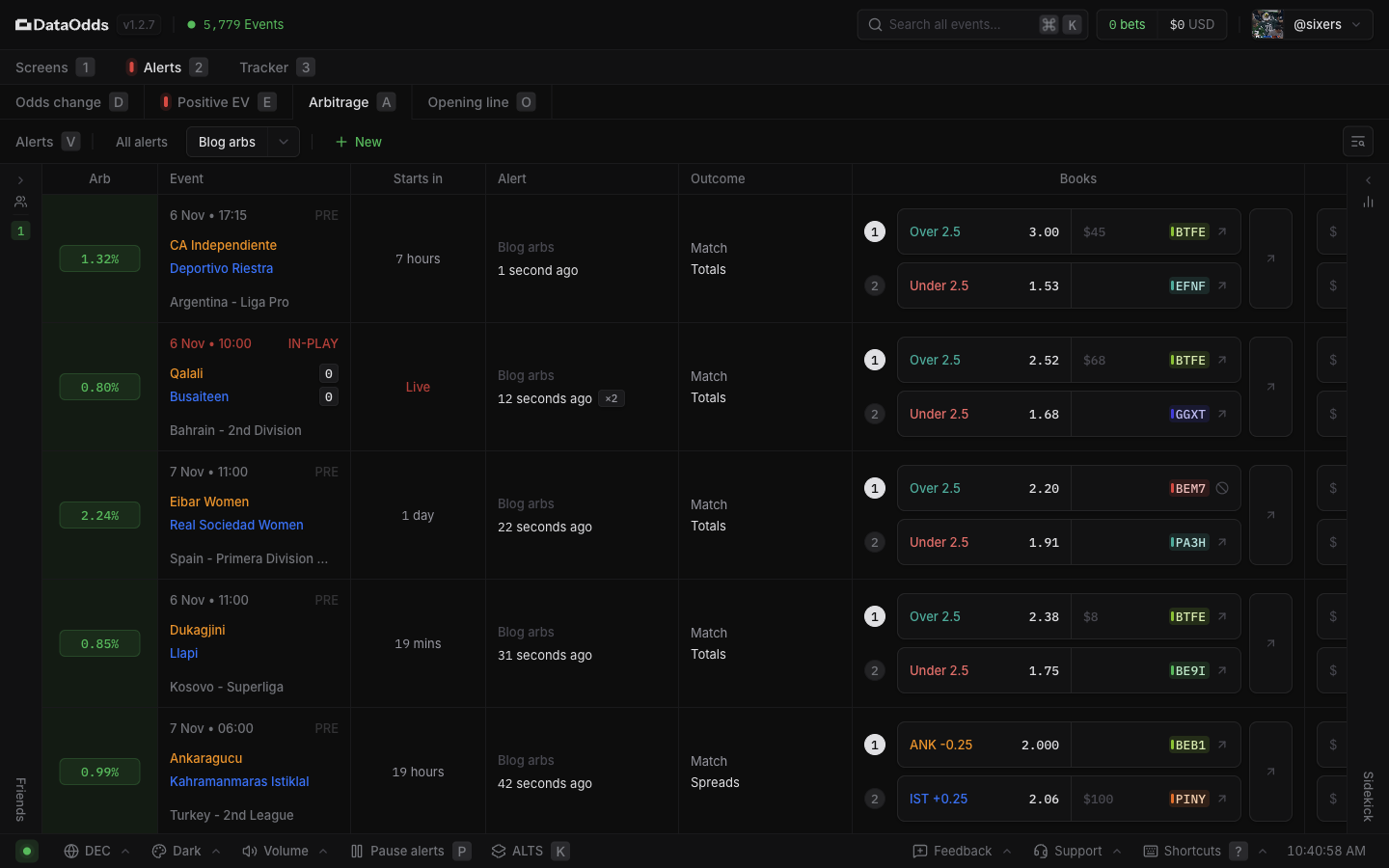
Take the top row: match totals, Over/Under 2.5 goals, CA Independiente vs Deportivo Riestra (Argentina Liga Pro), kickoff 17:15 ET that day. A 2.5-goal line can't push: the match ends with two goals or fewer, or three or more. That is exactly two outcomes, so two legs at two different books cover everything.
| Leg | Outcome | Price | Implied probability |
|---|---|---|---|
| 1 | Over 2.5 | +200 (3.00) | 33.33% |
| 2 | Under 2.5 | −189 (1.53) | 65.36% |
| Total | 98.69% |
S      = 1/3.00 + 1/1.53 = 0.33333 + 0.65359 = 0.98693
Margin = 1 / 0.98693 - 1 = 0.0132 = 1.32%
That is the 1.32% the row shows. Split $100 with the stake formula:
| Leg | Stake | Returned if it wins |
|---|---|---|
| Over 2.5 at +200 (3.00) | $33.77 | $101.31 |
| Under 2.5 at −189 (1.53) | $66.23 | $101.33 |
About $101.32 back on $100 whichever way the match goes, a margin of about $1.32, if both legs are filled at those prices.
Real stakes are usually rounded. The close-up below is the 2.24% row from the same feed: Eibar Women vs Real Sociedad Women, Over/Under 2.5 at +120 (2.20) and −110 (1.91), recorded at 10:41 ET. It shows whole-dollar stakes of $46 and $53. At those stakes, $99 staked returns $101.20 if the Over wins and $101.23 if the Under wins, within a few cents of the exact split.

One moment, not a typical rate: between 10:40:59 and 10:41:20 ET, the top of this feed showed arbs on seven different matches, with margins from 0.80% to 3.61%. Six were match totals and one was a quarter-line Asian handicap. Several came from lower divisions, such as Bahrain's 2nd Division, Kosovo's Superliga, Turkey's 2nd League and Ghana's Division 1. The widest, 3.61%, was Over 3.5 at +174 (2.74) against Under 3.5 at −150 (1.666) for Admira Wacker vs St. Polten.
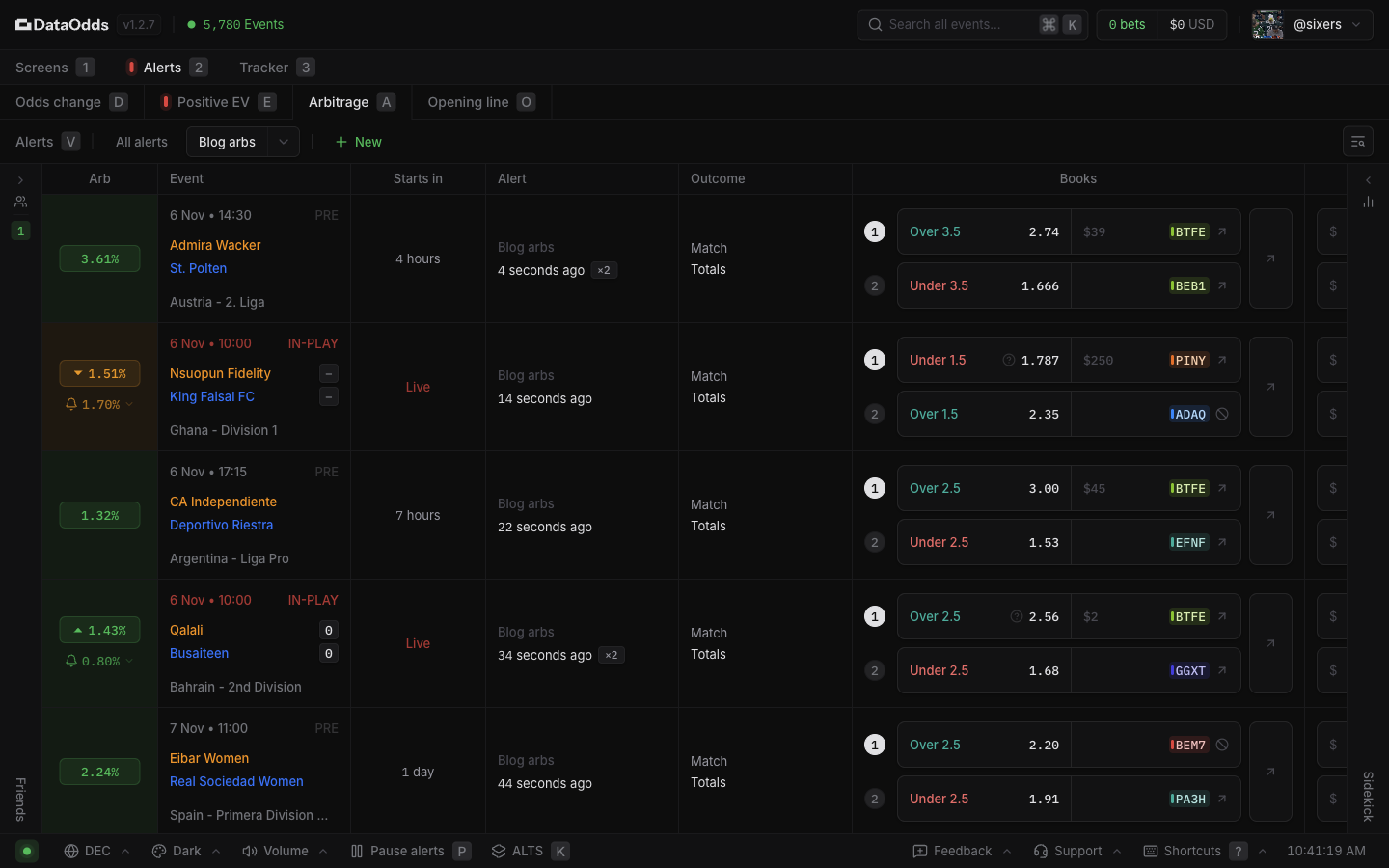
Prices move fast, too. The in-play Bahrain row was a 0.80% arb at 10:40:59 ET with the Over at 2.52. Twenty-one seconds later the Over was 2.56 and the same pair of prices worked out to 1.43%.
Which leg should you bet first, and what can go wrong?
Place first the leg most likely to move or be pulled. Leg risk is the chance that one leg is filled and the other price moves before you get it. DataOdds Arbitrage alerts mark the leg to bet first (release 1.2.7, 2026-11-03): it is leg 1 on every row. On the top row, leg 1 is the Over at +200 (3.00).
Here is what leg risk looks like. The close-up below is the same row 40 seconds later, at 10:41 ET. The Over is still 3.00, but the Under has moved from −189 (1.53) to −204 (1.49).

S      = 1/3.00 + 1/1.49 = 0.33333 + 0.67114 = 1.00447
Margin = 1 / 1.00447 - 1 = -0.45%
With the Over at 3.00, the Under has to be better than −200 (1.50) for an arb to exist. At 1.49 it isn't one. If you had already placed $33.77 on the Over, your choices would be:
| Choice | What happens |
|---|---|
| Cover now at 1.49 | Stake $67.99 on the Under; $101.76 staked returns $101.31 either way, about $0.45 short |
| Leave the Over alone | A normal single bet at +200 that wins or loses with the match |
| Wait for the Under to come back | It may or may not; the Over is uncovered while you wait |
None of these is the trade you planned. Here the marked leg held and the other leg moved: placing the right leg first lowers leg risk, it doesn't remove it.
Other things that break arbs:
- Stale prices. Many apparent arbs come from a book that hasn't updated yet, so the price is gone when you try to bet it. Since release 1.2.7, DataOdds alerts no longer fire on stale books. Still check the price on the bet slip before you confirm.
- Stake limits. A book may accept less than the split needs, which leaves the legs unbalanced.
- Voided bets. Books can cancel bets at prices they treat as errors, leaving the other leg standing alone.
- Account limits. Books may cut stakes on accounts that keep betting their outlier prices.
How do fees and settlement rules affect the margin?
Fees come out of the margin, and on a 1–2% arb they can take all of it. Exchanges usually charge commission on net winnings, and prediction markets charge fees of their own. Turn a commission into an effective price before you add up the implied probabilities:
Effective decimal (exchange back bet) = 1 + (decimal - 1) x (1 - commission)
On the top row, a commission of about 5.7% on net winnings would wipe out the 1.32%, on either leg. A smaller fee leaves a smaller margin. For exchanges and prediction markets, hover a price in DataOdds to see the order book, with fees included where known (release 1.2.5), and work out the margin from the price you will actually get.
Settlement rules matter just as much. Both legs must settle the same event in the same way:
- A two-way arb needs a two-outcome market. A soccer moneyline has three outcomes. Backing the home team at one book and the away team at another leaves the draw uncovered. Totals on a half line (Over/Under 2.5), draw no bet and Asian handicaps work as two-way markets.
- Same period. Most soccer markets settle on 90 minutes plus stoppage time. Markets that include extra time or penalties are a different bet, even if the names match.
- Whole and quarter lines. A whole line such as Over/Under 3.0 can push, so both books must refund the same way. A quarter line such as −0.25 / +0.25 (the fifth row in the first screenshot) splits each stake across two lines. A draw then settles half of each stake differently, so the return on a draw isn't the same as the return on a win. Work out every outcome, not just two.
- Abandoned or postponed matches. Void rules differ by book. One leg can be voided while the other stands.
How is arbitrage different from positive EV betting?
An arb backs every outcome across books, and its margin holds only if every leg is filled. A positive EV bet backs one side priced above a fair, no-vig estimate of its chance and accepts variance: it will lose often, and the edge only shows over many bets (see expected value in sports betting).
In DataOdds, the two are separate alert types. Positive EV alerts compare each price with your Sharp Line, a weighted blend of the sharpest books that you choose. Arbitrage alerts fire when prices across books let you back every outcome above your minimum margin. Either way, log your bets: the Bet Tracker records closing line value (CLV) on every bet you log, the difference between the price you took and the final price before the event starts. It's a useful check on whether your first legs were beating the market (why the closing line matters).
To see arbs like these, open the terminal, press 2 for Alerts and choose the Arbitrage tab to set an Arbitrage alert rule with a minimum margin, like the 0.5% rule used here. Live odds and alerts need a paid plan or the free trial. Silver covers pre-match odds and alerts, and Gold adds in-play alerts like the Bahrain row above. Signed out, you can still compare odds on a 15-minute delay. Open the DataOdds terminal.
Prices were recorded in the DataOdds terminal on 2026-11-06 at the times shown and have since changed. DataOdds is an information tool, not betting advice, and nothing here recommends a bet on any match. 21+. If gambling stops being fun, call 1-800-GAMBLER.