The Kelly criterion tells you what share of your bankroll to stake on a bet with an edge: your edge divided by your net odds. On a price of 1.571 (−175) against a fair price of 1.46 (−217), recorded in the DataOdds terminal on 10 November 2026, full Kelly is 13.3% of the bankroll. Most bettors stake half or a quarter of that, because the win probability that goes into the formula is an estimate. Staking too much can shrink a bankroll even when every bet has an edge; staking too little only slows it down.
What is the Kelly criterion in sports betting?
The Kelly criterion is a staking rule that sets each stake as the share of your bankroll that gives the fastest long-run growth, given your win probability and the odds. John L. Kelly Jr. published it in "A New Interpretation of Information Rate" (Bell System Technical Journal, 1956).
f* = (b × p − q) / b

f* = share of your current bankroll to stake
b  = net odds: decimal odds − 1 (profit per $1 staked)
p  = probability the bet wins
q  = 1 − p
In decimal odds there's a shorter version: f* = (decimal × p − 1) / (decimal − 1). The top line is the bet's expected value per $1, so full Kelly is your edge divided by your net odds. A 3% edge at even money (2.00) is a 3% stake; the same edge at 3.00 is 1.5%.
If the edge is zero or negative, the stake is zero. Kelly sizes an edge, it doesn't find one. And f* is a share of the bankroll you have now, so stakes shrink after losses and grow after wins. The fastest-growth part only holds if p is correct, and that's where the trouble starts.
Where does the win probability come from?
The usual source of p is the no-vig fair price at sharp books: take their prices, remove the vig, and convert the fair price to a probability with p = 1 / fair decimal odds. If you have your own model, the maths is the same, but now the stake is only as good as the model.
In DataOdds that fair price is the Sharp Line, a weighted blend of the sharpest books, which you choose. On the Comparison screen (C) it sits next to the best price for every outcome.
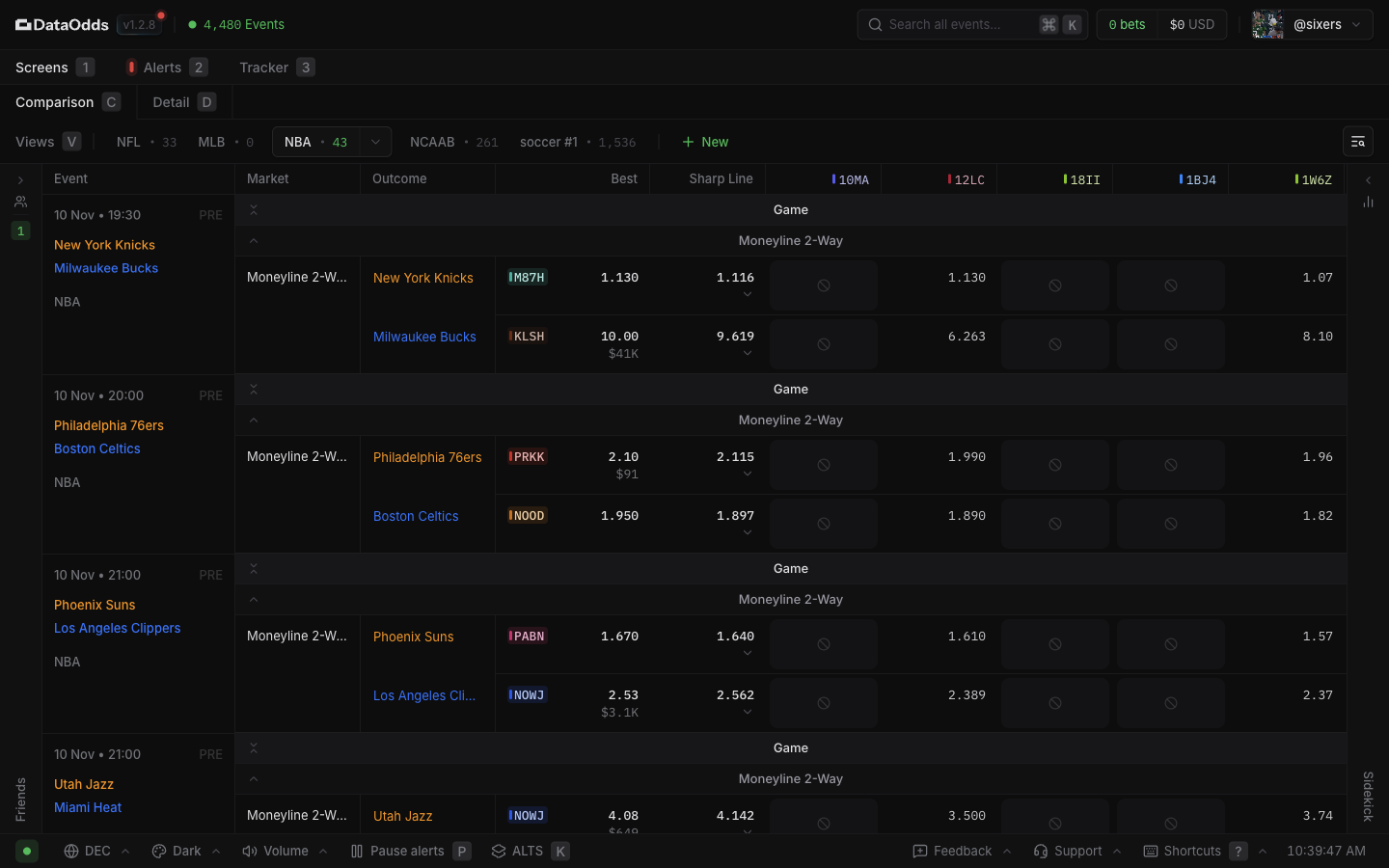
At 10:39 AM ET (15:39 UTC) on 10 November 2026, recorded in the DataOdds terminal, the Philadelphia 76ers v Boston Celtics moneyline showed these prices (the terminal was set to decimal odds, so decimal comes first here):
| Side | Sharp Line | Fair probability | Best price | Edge | Full Kelly |
|---|---|---|---|---|---|
| Boston Celtics | 1.897 (−111) | 52.7% | 1.950 (−105) | +2.79% | 2.9% |
| Philadelphia 76ers | 2.115 (+111.5) | 47.3% | 2.10 (+110) | −0.71% | 0 |
The two fair probabilities add to 100% (52.7% + 47.3%), so the margin is already out. Boston's best price beats its fair price: 1.950 × 0.5271 − 1 = 2.79%, and 0.0279 / 0.95 = 2.9% of bankroll at full Kelly. Philadelphia's best price is below its fair price, so b × p − q = 1.10 × 0.4728 − 0.5272 = −0.007, and Kelly says stake nothing.
Wherever p comes from, check it. Closing line value tells you whether your prices keep beating the close. If they don't, your p is probably too high, and Kelly will overstake every bet you size with it.
A worked example: Kelly stake on a Positive EV alert
Positive EV alerts fire when a price beats the fair price from your Sharp Line, so each alert row already holds both numbers Kelly needs.
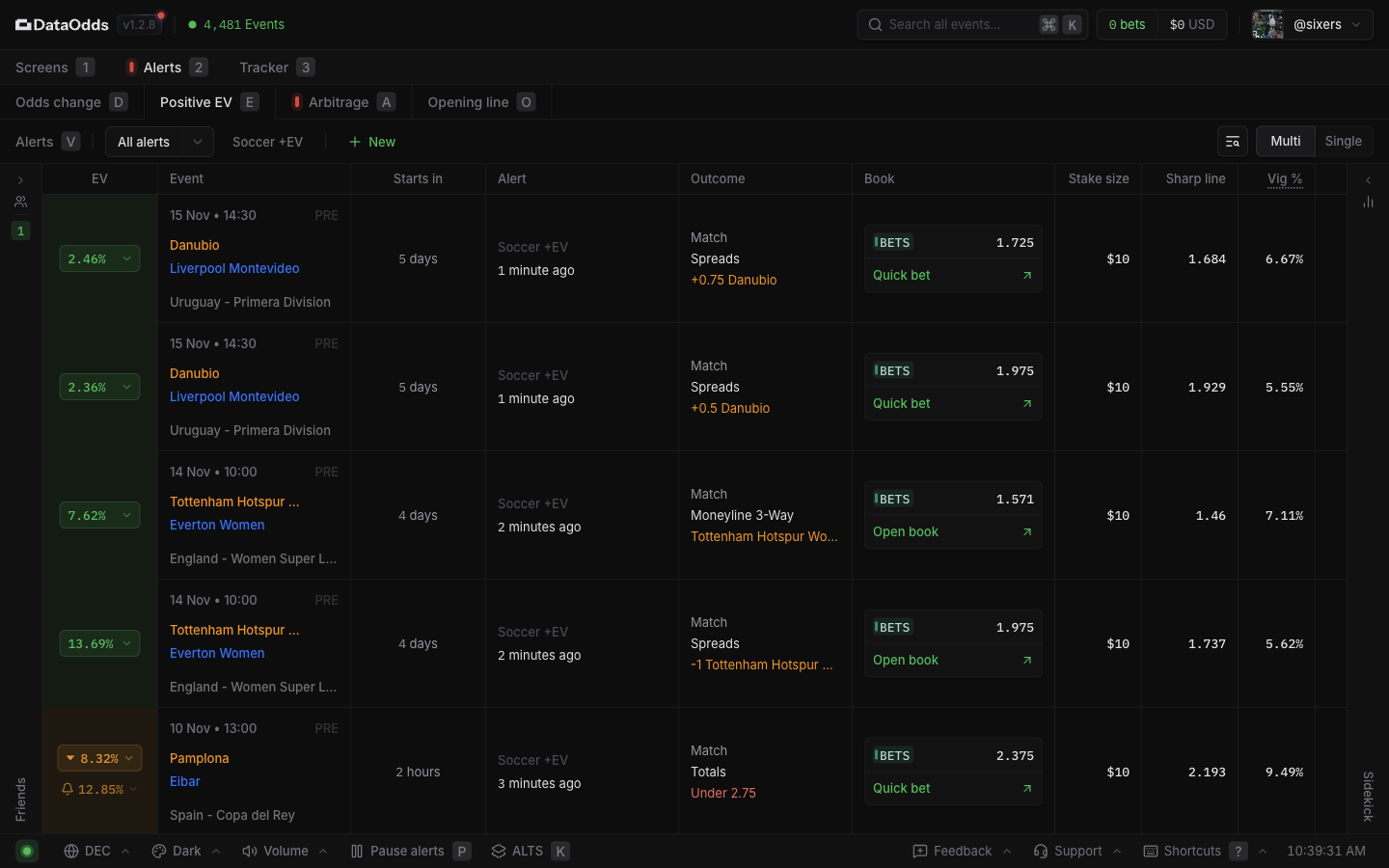
At 10:39 AM ET on 10 November 2026, the Positive EV list recorded in the DataOdds terminal showed five pre-match soccer alerts, each 1 to 3 minutes old. Take the third row: Tottenham Hotspur Women to beat Everton Women (3-way moneyline, Women's Super League, 14 November), best price 1.571 (−175), Sharp Line 1.46 (−217), EV shown as 7.62%. A 3-way moneyline bet either wins or loses (a draw loses), so the basic formula fits.
- Win probability: p = 1 / 1.46 = 68.5%, so q = 31.5%.
- Net odds: b = 1.571 − 1 = 0.571.
- Edge: 1.571 × 0.685 − 1 = 7.6%. (The alert says 7.62%; we're working from the rounded prices on screen.)
- Full Kelly: 0.076 / 0.571 = 13.3% of bankroll.
On a $5,000 bankroll (our example figure):
| Staking | Share of bankroll | Stake on $5,000 |
|---|---|---|
| Full Kelly | 13.3% | $666 |
| Half Kelly | 6.7% | $333 |
| Quarter Kelly | 3.3% | $166 |
Full Kelly puts 13.3% of the bankroll on one soccer match that, at the fair price, loses about one time in three. This shows the method, not a recommendation, and the prices are from one moment on 10 November.
How do exchange and prediction-market fees change the Kelly stake?
Fees lower your net odds b, and b sits in both the edge and the stake, so a small fee takes a big bite out of a small edge. On an exchange that takes commission on net winnings:
net b       = (decimal − 1) × (1 − commission)
net decimal = 1 + net b
Take the second alert row: Danubio +0.5 against Liverpool Montevideo (Uruguay Primera Division, 15 November), best price 1.975 (−103), Sharp Line 1.929 (−108), so p = 51.8%. A +0.5 handicap wins if Danubio win or draw, so it's a plain win-or-lose bet. Now put the same 1.975 on a hypothetical exchange and change the commission:
| Commission (hypothetical) | Net decimal | Edge | Full Kelly | Stake on $5,000 |
|---|---|---|---|---|
| 0% (the sportsbook price) | 1.975 | 2.38% | 2.45% | $122 |
| 2% | 1.956 | 1.37% | 1.44% | $72 |
| 5% | 1.926 | −0.14% | 0 | $0 |
A 2% fee takes about 42% off the edge and 41% off the stake. Above about 4.7% commission there's no edge left, and Kelly says stake nothing.
Prediction markets price a contract that pays $1 if it wins. If the venue charges a fee per contract when you buy, add it to the price before converting: net decimal = 1 / (price + fee). A hypothetical 49¢ contract with a 1¢ fee costs 50¢, so you're getting 2.00 (+100), not 2.04 (+104). With the same 51.8% fair probability, that moves full Kelly from 5.6% of bankroll to 3.7%. Some venues charge on winnings instead, which works like exchange commission, so check how yours charges before you size.
DataOdds sizes Kelly stakes on exchanges and prediction markets after known fees (release 1.2.4, 27 October 2026). Hover an exchange or prediction-market price to see its order book, with fees included where known. Where a fee isn't known, adjust b yourself.
Why do most bettors use half or quarter Kelly?
Because p is an estimate, and full Kelly only gives the fastest growth when p is exactly right. Stake more than about twice the right Kelly fraction and the bankroll's expected growth rate turns negative, even though every bet still has an edge. Staking too little only costs growth.
Back to the Tottenham Women bet. You estimated p at 68.5% and sized on that. The table compares each staking level with the right stake if the true probability was 1, 2 or 3 points lower. Multiples are your stake divided by the right stake.
| True win probability | True edge | Right stake (full Kelly at true p) | Your full Kelly (13.3%) | Your half Kelly (6.7%) | Your quarter Kelly (3.3%) |
|---|---|---|---|---|---|
| 68.5% | 7.6% | 13.3% | 1.0× | 0.5× | 0.25× |
| 67.5% | 6.0% | 10.6% | 1.26× | 0.63× | 0.32× |
| 66.5% | 4.5% | 7.8% | 1.70× | 0.85× | 0.43× |
| 65.5% | 2.9% | 5.1% | 2.63× | 1.32× | 0.66× |
At three points too high, full Kelly is 2.6 times the right stake. Over many bets like that, the typical full-Kelly bankroll shrinks: expected log growth works out to about −0.13% per bet, against about +0.07% at half or quarter Kelly. Every one of those bets still has a 2.9% edge. And three points is a small miss; this price only stops being +EV below 63.7% (1 / 1.571).
When p is right, fractional Kelly costs some growth and cuts the swings a lot. Staking a fraction k of Kelly earns about k × (2 − k) of full Kelly's growth rate: 75% at half Kelly, about 44% at quarter. Under the usual continuous approximation (Edward O. Thorp, "The Kelly Criterion in Blackjack, Sports Betting, and the Stock Market"), the chance the bankroll ever drops to half its starting size is about 50% at full Kelly, 12.5% at half Kelly and under 1% at quarter Kelly.
Positive EV bets lose often, at any stake size. Kelly decides how much a losing run costs you, not whether it happens.
How do you size several bets open at the same time?
Kelly for one bet assumes it's the only one open. With several open, staking each at its own full Kelly puts more of the bankroll at risk than the formula intends, and bets on the same match can double up on one result.
The alerts list above has both problems. Rows 1 and 2 are both Danubio on the handicap in the same match (+0.75 and +0.5). Rows 3 and 4 are both Tottenham Hotspur Women in the same match: the 3-way moneyline and the −1 handicap. If Tottenham Women win by two or more, both bets win; if they draw or lose, both lose (a one-goal win wins the moneyline and refunds the handicap). Full Kelly on the moneyline alone is 13.3%, so a second full stake on the handicap piles more on top of that, riding on the same result.
Two habits keep this in check:
- Treat bets on the same match and side as one position. Size one Kelly stake for the position, then take the bigger edge or split that one stake between them.
- For bets on different matches, add up the stakes. If the total goes over a cap you set in advance, scale every stake down by the same factor. Exact Kelly stakes for several bets at once come out a bit smaller than each bet's single-bet Kelly, and staking a fraction of Kelly covers most of that gap.
Size from the bankroll you have now, not the one you started with. The Bet Tracker takes a starting bankroll and records profit and CLV on every bet you log, so you can work out the current figure and see whether your bets beat the close.
To size your own bets this way, press 2 for Alerts in DataOdds and open Positive EV: each alert shows the best price and the Sharp Line, the two numbers Kelly needs. Live odds and alerts need a paid plan or the free trial. Open Positive EV alerts in DataOdds
DataOdds is an information tool, not betting advice. Kelly sizes bets; it doesn't make them win, and full Kelly can mean deep drawdowns. 21+. Gambling problem? Call 1-800-GAMBLER.